Solving Newton Rings and other Pitfalls of Polymer Photogravure

Proofing the Plate

The thrill of victory… and the agony of defeat is a quote by the late sportscaster Howard Cosell that actually defines the span of emotions printmaking offers to the casual and professional practitioner! While there are many disappointments along the path, there is nothing as elating as pulling that perfect print you’ve been working on for days.

For those of you working with DTP (or direct-to-plate, this info may still be relevant since Newton Rings typically occur between the film positive and the plate. This is because inkjet film is porous, and made to hold moisture (specifically ink). The plate surface also has moisture (as well as a light coating that rinses off in the first few seconds of plate processing).  This moisture between the film and the plate is usually the cause of this pesky mottling, sometimes referred to as “measles”. It is characterized by wiggly patterns and collections of dark spots as shown below.
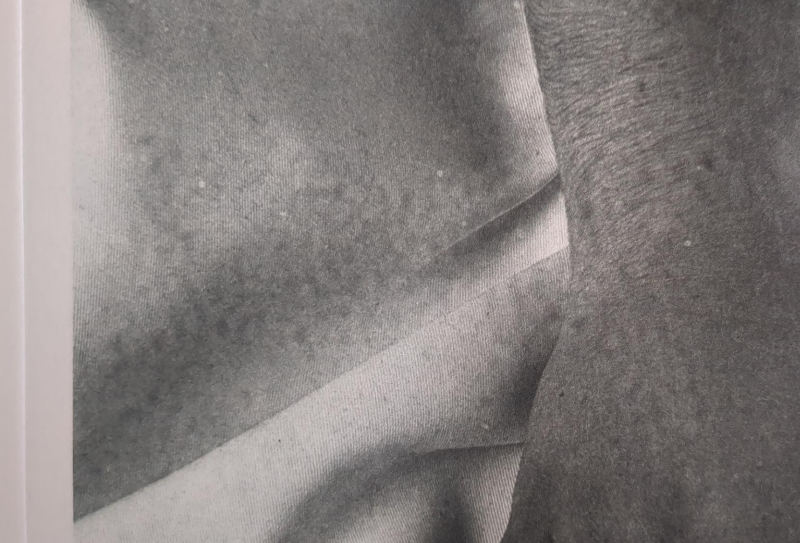
Newton ring example.

Newton ring mottling example in print
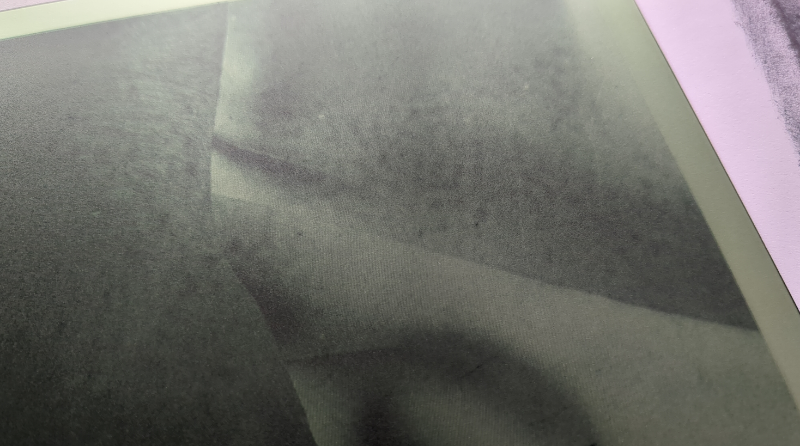
Newton ring example on plate.

Newton ring mottling example on plate.

In the exposure unit, Newton Rings are clearly visible in the example below as rainbow-iridescent patterns under the glass. These colored patterns block light from getting to the plate, causing unwanted patterns.
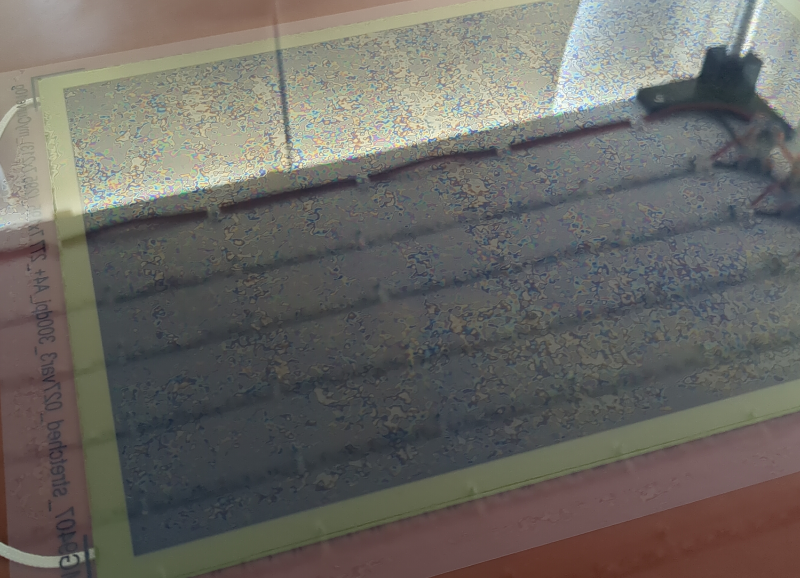
Newton rings forming prior to exposure.

Newton rings forming prior to exposure.

We do several things to prevent Newton Rings:
  1.  Dry the film positive in open air for 2-24 hours. then in a heated print drier for 10-12 minutes before exposing. A hair drier will work too.
  2.  Before aligning and exposing film positive, dust plate with baby powder lightly then brush away as much as possible,
  3. The main way we eliminated Newton Rings at Intaglio Editions was to replace the glass in our frame vacuum with Kreene plastic, as suggested to us by the kind folks at Boxcar Press, in Syracuse, NY. See the link to our full workflow at the bottom of this article.

Another common issue with platemaking is dust specks.  These look like a small, pure black, pinprick-sized dot, with a white halo around it.  This is caused by dust getting trapped between the plate and aquatint screen. We mitigate it in the shop by having air purifiers running near the exposure unit, and by wiping down the vacuum frame with anti-static cleaner before every plate made.

When troubleshooting, make sure your aquatint screen is clean too, and isn’t showing any of the same patterns, as you’re seeing in the print. I found that storing an aquatint screen on top of some unexposed plates for a period of time caused condensation to form on the screen, which showed up as mottling in subsequent plate exposures. The light residue was easily removed with film cleaner, but I wasn’t expecting that to be an issue, until it was.

Thanks to At Honig for their photo documentation.

View my full, but somewhat outdated, Polymer Photogravure Procedure here.

Working on a project with a budget means minimizing expenses. Save yourself massive headaches, months of testing, and thousands of dollars learning platemaking and order custom plates from Intaglio Editions in Colorado USA at https://shop.intaglioeditions.com  


Photopolymer Gravure Process Q&A

I get several emails a year asking questions and for clarifications about photogravure done with polymer plates and my company’s intaglio workflow procedure for doing it.  Good questions are usually asked more than once, so I like to publish them when they are to help prevent the need for answering the same question multiple times.  I also use the information to refine my procedure.

Return-Path: <sandtrad@cmn.net>
From: Bill and Barbara Sanders <sandtrad@cmn.net>
Content-Type: multipart/alternative; boundary=Apple-Mail-23–66191753
Subject: polymer gravure artists
Date: Wed, 6 Jun 2012 15:31:00 -0600

Dear Jon,

Found your website and information from Boxcar Press and would like to discuss a few art things with you. I talked with my friend Patricia Brandstead this morning and she said you are a good resource for someone learning polymer photogravure.

A little bit of background: I have been a printmaker for 30+ years starting in Honolulu and have been making copperplate photogravures for 25+ years both in Hawaii and Colorado. This spring, returning to Hawaii and meeting up with printmakers there, I was kindly shown how to make polymer photogravures as an alternative to copper. I returned with 5 lovely etched plates! My studio is in Steamboat Springs (where Oehme Graphics is) and I have a small Brand press and a NuArc NL22-8C exposure unit. I am able (usually) to make transparencies in my Epson printer with PictoricoOHP film and I have a great screen from Mark Nelson. More “equipment” is ordered.

I have a feel for the basic “flow” of the process but have a few sticky challenges:

1. my exposure unit is a glass-topped vacuum frame which I think needs to be modified, with Kreen film?, to work with the polymer KM73 plates. Don’t have a clue how to do that

2. cutting the plates seems to be a challenge so I’m going up to Oehme Graphics to attempt to use their plate cutter

3. I have no idea of exposure units except for the times I use for copper and figuring out the curves etc are way beyond me. I have the transparencies made (by a friend) to compare to the ones I use for copper

Do you give workshops?
Does anyone?

I’ve downloaded your instructions from your site — they’re great. Would appreciate feedback as I’m feeling the polymer plates are even better than the copper!

Sincerely,
Barbara Sanders

~^*~^*~^*^~*~^*~^*~^^*~~^*^*~~^*~^*^~*^~*~^

Hi Barbara,

Thanks for your message.  Ironically I “pocket called” Patricia this morning by accident!  Polymer has some challenges, but what doesn’t?  It is a rewarding medium, but it did take some time to get happy with it, or it with me.  🙂

I removed the glass from my vacuum frame years ago to prevent newton rings which Harold Kyle at Boxcar advised me on, and I never looked back.   If you don’t have issues with newton rings, no need to even do it.  My online procedure outlines what has worked for me and my process. Yours may be different. Since that time Pictorico has released a textured OHP media which may prevent newton rings.  It also supposedly eliminates the need for baby powder which I used to prevent contact problems between the plate and the OHP, which tends to be a little tacky.  I’ve never used it, but you might try it before going through the pain of dismantling your vacuum frame and removing the glass.

I’m using a custom aquatint screen that is considerably finer than those commercially available, among which, Mark Nelson’s are probably the best for polymer photogravure using the Toyobo KM73 plates.  He also gives workshops a few times a year that are quite popular and well received.  He has a special process for creating digital negatives and curves using colored inks on Epson printers that is rather involved but yields good results.  I was never able to get it to work for me, but it could be because my aquatint screen is finer, which is a double-edged sword.  Greater tonal range, but more pressure and contact is required in both the printing and creation of the plates.

I use a large, Kutrimmer, floor model paper cutter to cut and trim out plates.  You want something sturdy, sharp, and tightly assembled.  Wobbly ones ruin plates and patience!

Exposure times will be custom to your exposure unit and media used.  My exposure times will likely be different from yours.  Same with curves.  Your inkjet printer will differ from mine such that, even if we have the exact same models, the output will differ.  Determining the right curve to use is an iterative process — lots of trial and error as with most things printmaking and you’ll want some basic training in Photoshop to become familiar with using curves as an Adjustment Layer.  Lynda.com has some great Photoshop tutorials.

If you’re consistent in your test process, you will get where you want to be with it eventually.  I don’t give workshops, but I do make plates for printmakers, and give private consultations through my company Intaglio Editions: http://intaglioeditions.com  I’m also happy to share whatever information might be helpful to you in your pursuit of the process.  If you’d like to do a private consultation on the process either over the phone or in person, at your studio or mine.  It seems pricey I know, until you compare it to the thousands of dollars in time, plates and paper I’ve blown over the years!  Call me if you want to discuss it or have any other questions.

Also, would it be OK with you if I were to reprint your questions and my answer on my website?  I’ve found it helps people get answers they need more easily sometimes.

Kind regards,
Jon Lybrook